What is Jet Lag? Causes, Risks, and Rapid Recovery

Think of jet lag as your body's internal clock being stuck in your old time zone while you're already in a new one, leaving you feeling totally out of sync and exhausted.
What is Jet Lag?
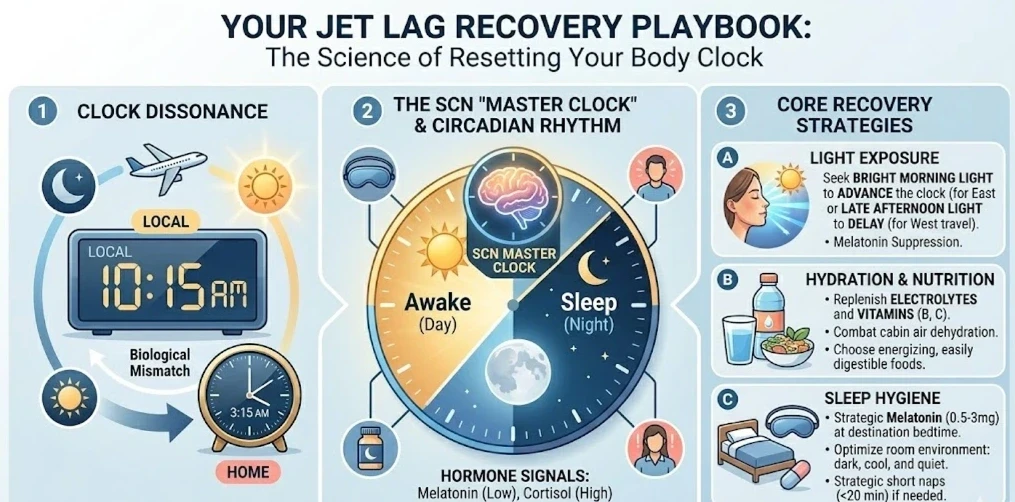
Jet lag, or circadian desynchrony, is a temporary sleep disorder that occurs when your body’s internal clock (circadian rhythm) is out of sync with a new time zone. Jet lag is caused by rapid long-distance travel across multiple meridians. When you travel across multiple time zones rapidly, your SCN is still synced to your "point of origin," while your environment demands a new schedule. This "biological lag" results in the physical and mental fatigue we know as jet lag. To get rid of jet lag fast, you must manually "reset" your internal clock using strategic light exposure, hydration, and controlled sleep windows.
What Causes Jet Lag?
The core cause is the disruption of the circadian rhythm, a 24-hour cycle managed by the suprachiasmatic nucleus (SCN) in the hypothalamus.
Light-Dark Cycles: The SCN uses light to regulate melatonin and cortisol. Rapid travel confuses these signals.
Atmospheric Pressure: Low oxygen levels and dry air in airplane cabins can exacerbate physical fatigue.
Directional Bias: Traveling East forces the body to "advance" its clock, which is biologically more difficult than "delaying" it (traveling West).
5 Common Symptoms of Jet Lag
Before you can treat it, you need to identify it. Most travelers experience:
Insomnia or Excessive Sleepiness: Feeling wide awake at 3 AM and crashing at 2 PM.
Cognitive "Fog": Difficulty concentrating or memory lapses.
Gastrointestinal Issues: Indigestion, constipation, or loss of appetite.
Mood Swings: Irritability or mild anxiety.
Physical Fatigue: Muscle soreness and general malaise.
Possible Complications of Jet Lag
While often viewed as a minor inconvenience, chronic or severe jet lag can lead to:
Impaired Cognitive Function: Reduced alertness, slow reaction times (dangerous for business travelers or drivers).
Digestive Distress: Constipation, diarrhea, or indigestion as the "gut clock" lags behind.
Hormonal Imbalance: Disruption in cortisol and insulin sensitivity.
Weakened Immune System: Travel stress plus sleep loss makes you more susceptible to "traveler's flu" or local viruses.
The abrupt shift in your sleep-wake cycle spikes your stress hormones, specifically cortisol, which keeps you wired at night. Learning how to lower cortisol levels biologically is essential not just for sleep, but for helping your entire system settle into a new time zone without the physical 'crash'.
Risk Factors for Developing Jet Lag
Not every traveler suffers equally. Your susceptibility depends on several biological and environmental variables:
Number of Time Zones Crossed: Generally, crossing three or more time zones triggers noticeable symptoms.
Direction of Travel: Traveling East is statistically harder on the body than traveling West (it's harder to "lose" time than "gain" it).
Age: Older adults may take longer for their internal clocks to recalibrate.
Baseline Sleep Quality: If you are already sleep-deprived before takeoff, your symptoms will be magnified.
Alcohol and Caffeine Consumption: These substances dehydrate the body and interfere with the ability of the brain to enter deep REM sleep during transit.
How is Jet Lag Diagnosed?
There is no lab test for jet lag. Diagnosis is clinical, based on your recent travel history and a cluster of symptoms (insomnia, daytime fatigue, and GI upset). If symptoms persist for more than two weeks, a specialist may use actigraphy (a wearable device) to monitor your sleep-wake patterns to ensure a more serious sleep disorder isn't present.
How to Minimize the Impact of Jet Lag: The "T-Minus" Protocol
Recovery starts before you even board the plane.
1. The Pre-Flight Shift
If you are traveling East, try going to bed one hour earlier each night for three days before departure. If traveling West, stay up one hour later. This "micro-adjusts" your circadian rhythm before you hit the tarmac.
2. The 2-Hour Rule for Flights
Many travelers ask, "What is the 2-hour rule?" In the context of travel recovery, if your arrival time is within 2 hours of your normal wake-up time, stay awake. If you arrive late at night, avoid any caffeine within 2 hours of landing to ensure your body is primed for its first "local" sleep cycle.
3. Master Light Exposure
Light is the primary signal for your brain’s master clock.
Need to stay awake? Seek bright sunlight or use a blue-light lamp.
Need to sleep? Wear blue-light-blocking glasses or high-quality eye masks to signal melatonin production.
How Can You Avoid Jet Lag?
Prevention is about "pre-syncing" your body:
The Transition Phase: Three days before travel, move your bedtime closer to your destination's time zone.
Strategic Fasting: Some travelers use the "Argonne Anti-Jet-Lag Diet," alternating feasting and fasting to reset the metabolic clock.
Hydration is Non-Negotiable: Cabin air has roughly 10-20% humidity, which is drier than the Sahara Desert.
The changes in atmospheric pressure during flight can trigger lingering migraines. Travelers can often find relief by monitoring localized barometric pressure reports to understand how environmental shifts are impacting their post-flight recovery.
Why am I still jet-lagged after 4 days?
It typically takes about one day per time zone crossed for the body to naturally adjust. If you crossed eight time zones, your "biological clock" may lag for a week.
Is jet lag worse going forward or back? Most people find traveling East (forward) to be much worse. This is because it is harder for the human body to "shorten" its day than it is to "lengthen" it (traveling West).
If your recovery seems to have stalled, it’s worth considering that jet lag can often mask or worsen underlying nutrient deficiencies that trigger chronic fatigue. Addressing these core imbalances is often the missing piece in reclaiming your energy levels after a long flight.
How to Get Over Jet Lag: The Treatment Protocol
If you’ve already landed and feel like a "zombie," traditional advice tells you to drink water and wait. However, for those who need to be "on" immediately, we use a more aggressive recovery protocol.
1. Resetting the Clock with Light
Seek 15–30 minutes of direct sunlight as soon as you wake up in the new time zone. This suppresses melatonin and signals your brain that the day has begun.
2. Strategic Supplementation
Low-dose melatonin taken 30 minutes before your desired bedtime in the new time zone can help "force" the shift.
3. The Professional "Shortcut": IV Therapy
When you are severely jet-lagged, your cells are often "pruned" of moisture and essential nutrients. Oral hydration has a limited absorption rate (approx. 50-60%).
IV Therapy for Jet Lag provides:
100% Bioavailability: Immediate hydration that reaches the brain and muscles instantly.
Electrolyte Restoration: Balances the sodium/potassium levels that regulate nerve function and energy.
Vitamin B12 & B-Complex: Essential cofactors for cellular energy production (ATP), helping to clear "brain fog" without the crash of caffeine.
Vitamin C & Zinc: Bolsters the immune system to prevent complications from travel-related germs.
Recovery Tip: An IV Jet Lag drip is most effective when administered within the first 24 hours of arrival. It addresses the physical exhaustion, allowing you to focus entirely on the mental task of adjusting your sleep schedule.
Can Jet Lag Last 2 Weeks?
While rare, if you cross 10+ time zones or have underlying sleep issues, symptoms can linger. If you are still feeling "off" after 14 days, consult a professional to rule out other fatigue-related conditions.
Is Jet Lag Worse as You Get Older?
Yes. As we age, our circadian rhythms become less flexible, and melatonin production naturally decreases, making it harder for the body to "snap back" after long flights.
Is Jet Lag Worse Going Forward Or Back?
Yes, traveling "forward" (East) is generally much harder than traveling "back" (West). When you fly East, you lose hours, forcing your body to fall asleep earlier than its internal clock is ready for. It is biologically easier for humans to stay up later than to force sleep.
What Does Bad Jet Lag Feel Like?
Bad jet lag feels like a heavy "brain fog" combined with physical exhaustion, similar to a mild flu. You may experience a "thick" feeling in your head, intense irritability, stomach discomfort, and the sensation of being wide awake at night while feeling like a "zombie" during the day.
What Not To Do For Jet Lag?
Do not take long naps during the day, as this "locks in" your old time zone. Avoid excessive caffeine and alcohol, which further dehydrate your system. Finally, don't stay in a dark room all day; without sunlight, your brain won't receive the signal to stop producing melatonin and wake up.